Encountering the Unexpected on Familiar Trails
Glimpse Ahead: Even the most familiar paths can surprise us. Sometimes what blocks our way becomes the very thing that reveals resources we didn’t know we were carrying. This essay looks at how things change when we don’t know what’s coming, and how the things that seem to hold us back can show us how we adjust to new situations.
When the Familiar Becomes Unfamiliar
I’ve walked this trail dozens of times. The same loop, the same landmarks, the same spot where I let the dogs wade, the same comforting sense of rhythm. This path requires minimal mental energy because of my knowledge of its nature. Turn here, watch for roots there, and arrive at the water’s edge in about the same number of steps as always.
But today, rounding the familiar bend, I stopped short. The trail ahead is underwater. Not just the edges where it sometimes gets muddy, but the entire path submerged under three feet of lake water. The recent rains have raised the water level far beyond what I’ve ever seen, especially this late in May, when water levels have receded.
My first response is surprise, then disappointment. This path is not what I desired or what I expected. For an instant, I stood, observing water cover what should be solid land. The familiar has become unfamiliar.
The Pause That Changes Everything 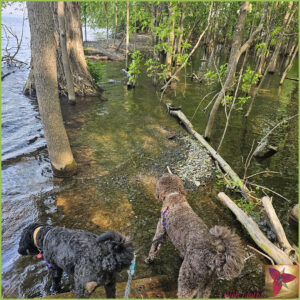
Instead of turning around in frustration, I paused. I let myself feel the disappointment without rushing past it. The flooded trail resembles something novel, nearly resembling a tiny lake within the woods. There’s something about accepting what is, rather than fighting what isn’t, that shifts my perspective. This opens space, not just for alternatives, but for an unexpected invitation to emerge.
Then, I assess my options. I could get wet and walk through it. Jaxyn and Dahlia would be fine with that. I could turn back, cut the hike short, let the unexpected undo the plan. Or I could take one of the alternative routes I’ve explored over the years. I wandered down routes out of curiosity, not knowing they would someday become necessary.
That’s when I realize something important. My past exploration, driven by nothing more than openness and curiosity, had prepared me for this moment. Those “random” detours, those times I wondered, “Where does this path lead?” had given me options I didn’t know I was creating.
The Stones We Carry
This flooded trail is a perfect metaphor for how we encounter obstacles in life. We carry certain stones, certain expectations about how things should unfold. We predict the familiar will stay familiar, that well-traveled paths will remain passable. These predictions make life easier; they save mental energy and let us move forward without reevaluating every step.
Until they don’t.
Our expectations and predictions, the stones we carry, become obstacles when reality shifts. That secure job has disappeared. Changes are happening in the stable relationship. Our health, which we took for granted, needs attention. Our worn identity no longer fits.
These are the moments when the familiar becomes unfamiliar, when our mental maps no longer match the terrain in front of us. The unexpected can occur even on the most well-traveled paths of our lives.
The Stones We Discover
But here’s what occurred to me standing at that flooded trail: obstacles often reveal resources we didn’t know we were carrying. The same curiosity that led me to explore alternative routes years ago becomes the flexibility I need today. The same openness that made me wonder “what’s over there?” becomes the adaptability that keeps me moving forward.
We discover we’re carrying stones of resilience, creativity, and problem-solving capability. Stones polished by previous experiences, by times we’ve had to adjust course or try something new. These inner stones were always there, but sometimes it takes an unexpected obstacle to reveal them.
The key is in our response. We can resist the change, complain about the flooded trail, insist that things should be the way they always were. Or we can pause, assess, and ask ourselves: what options do I have that I haven’t considered? What resources am I carrying that I’ve forgotten about?
A Soulful Response to the Unexpected
When the unexpected blocks our path, we need what I call a soulful response.
This signifies bringing appreciation for what is, even when it’s not what we planned. This implies reflection about what this change might teach us. This suggests openness to new possibilities instead of rigid attachment to old plans.
A soulful response means staying present with disappointment while also staying curious about the alternatives. It means acting from a place of flexibility rather than force. It means connecting with our inner resources, the stones of adaptability and resilience we’ve gathered through previous experiences.
It means remembering that we’re neurologically capable of change and adaptation, but we have to choose to use that capacity. If we just complain or resist, those patterns can dig in even deeper. But if we stay open and responsive, we can discover new pathways we never knew existed.
The Trail Continues
I ended up taking a different route that day, one that offered views I hadn’t seen in a long time. The detour became its own kind of gift, revealing parts of the landscape I’d almost forgotten about. The flooded trail didn’t stop my journey; it just changed the course.
Sometimes the unexpected on familiar trails isn’t a problem to solve but an invitation to explore. Sometimes what looks like an obstacle is an opportunity to discover assets we didn’t know we were carrying.
The trail continues, even when it doesn’t look like the trail we expected to walk.
Questions to Consider:
When has an unexpected obstacle revealed resources you didn’t know you had?
What side trails or “alternative routes” have you explored in life that might serve you when familiar paths become blocked?
How might you respond more soulfully the next time the familiar becomes unfamiliar?