The Threshold Season: What Mud Season Doesn’t Name
The bloodroot isn’t up yet.
That was what I went looking for on my first hike of the season in mid-April. My first hike in months and since receiving CAR-T treatment and spending several weeks in the hospital. I wanted to see if the bloodroot was peeking through in the spot where it always comes up, in the woods near the grassy stretch where the trail bends back toward Lake Champlain at Point au Roche park in very upstate NY. I was a little early. No bloodroot. No trillium. No wildflowers of any kind. The pines were green, as pines are, but the hardwoods hadn’t decided yet. The grass was greening. The ground was mostly last autumn’s leaves, still flat and brown, with mud where the snow had been.
I caught myself thinking of it as pre-spring. Then pre-post-winter. Then it came to me. Locals have a name for this, of course. Mud Season. Vermont and the Adirondacks’ unofficial fifth season, running from snowmelt through Memorial Day. It’s when the ground thaws from the surface down while frozen layers beneath trap meltwater, creating the legendary mud that closes high peaks trails, ruts dirt roads, and keeps boots caked for weeks.
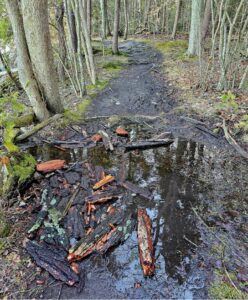
There are festivals celebrating it. Montpelier’s MudFest, music nights at local breweries, maple sugaring demonstrations that overlap with the thaw. It’s a season Vermonters and Adirondackers have learned to embrace, or at least endure, with a particular regional pride.
A season without an official name
Mud season is accurate for what it describes. The physical reality of saturated trails and spinning tires. But standing in those woods, I realized it names what the ground is doing, not what it’s becoming. It captures the inconvenience, the mess, the practical challenge of moving through this landscape. What it doesn’t capture is the quiet preparation happening underneath. The sense that something is gathering itself, sealed but swollen, not yet ready to show its shape.
We have names for the four big ones. We have names for their midpoints, the solstices and the equinoxes. The hidden aspect of this time period after the snow has mostly melted but before anything has decided to bloom. It isn’t winter. The ice is off the lake. The days are long enough.
It isn’t spring. Nothing is coming up yet.
It is the threshold.
The ground is getting ready. You can feel it in the air. A smell and a feel, as I found myself describing into my recorder, “not quite having come to life yet, but getting ready to do so.” The forest floor is holding something. The buds on the trees are sealed but swollen. The bloodroot is down there somewhere, under last year’s leaves, doing whatever bloodroot does in the week or two before it breaks the surface.
We tend to skip over this season. It isn’t photogenic. It isn’t dramatic. It doesn’t lend itself to Instagram. There’s no blazing foliage, no dogwood in flower, and no ubiquitous green. Just brown ground, bare branches, and mud.
But it has its own integrity. And I think it has something to teach.
After the thaw
We celebrate Mud Season with festivals and craft beer releases, turning the mess into community ritual. We share survival tips and complain about the roads. But the inner work – the threshold work – doesn’t have its own festival.
Our cultural scripts around difficulty are heavy on rebirth. Get through the hard winter, and spring comes. Survive the illness, and you are renewed. The phoenix rises. The caterpillar emerges. The hero returns transformed.
These are beautiful stories. They are also, in my experience, as a clinician and as a person, often premature. What actually happens after a hard passage, a serious illness, a loss, a treatment that has reshaped your body and your expectations; is rarely rebirth. It is something subdued and more ambiguous. You are not who you were. You are not yet who you will be. You are still mostly last autumn’s leaves, with something stirring underneath that hasn’t decided its shape.
That is pre-emergence.
It is not rebirth. It is not even spring.
It is the threshold season, and it deserves its own name and its own respect.
What the threshold asks
Walking through the woods that afternoon, I wasn’t looking for renewal. I was checking. Checking my balance. Checking my heart rate. Checking whether my legs remembered how to do this. Checking whether the bloodroot was up yet. Checking what was still here from before, and what was beginning to stir.
The threshold season asks for a particular kind of attention. Not the vigilance of winter, where you watch the ice and the cold. Not the eagerness of spring, where you count the blossoms and celebrate renewal. Something more like taking inventory. What made it through? What is gone? What is gathering itself?
This is the work after a difficult passage. Before you can say what you have become, you have to look at what is actually there. The remnants of the old. The not-yet of the new. The mud in between, where the path still gets soft under your boots and you have to pick your way carefully.
Rushing to declare yourself renewed is a way of skipping this. And something gets lost when we skip it. The threshold is where the real reorganization happens. Underground, under last year’s leaves, before what is emerging has to show itself.
Walking early
I was earlier than the bloodroot. I noticed that, on the trail, and then I noticed I was a little proud of it. I had gotten out before the wildflowers did. I was ahead of the emergence.
That is not nothing. Sometimes the work of the threshold season is simply being out in it. Not producing anything. Not blooming yet. Just walking the trail, one careful step at a time, on legs that are remembering what they know how to do.
The bloodroot will come. It always does. But it will come in its own time, and not because anyone walked past it hoping.
For now, there is this: the pines green as always, the mud where the snow was, the dogs sniffing something only they can smell, and the quiet understanding that I am in the threshold season.
That is enough.
This piece was written after my first hike of the season in the Adirondacks, mid-April, the first trail walk since my CAR-T treatment. The bloodroot wasn’t up yet. Neither was I, really. But we were both getting ready.